 Rui Carmo
It’s a bit insane that we’re past mid-September and my living room is still sitting at 29oC at 7AM, but such is life in the late Holocene, I guess. Regardless, the shift towards Autumn is starting to show, and I’ve had a couple of days where I suddenly realized I was working “late” into the evening and the lights started coming on automatically (never a good sign unless you’re having fun).
I have had to split my free time between a bit of stress at work and working on my health (neck, posture, back, exercise and other things). Yet, things keep happening.
Social Cleanup
Halfway through the week I decided (again) to do a couple of minor interventions and remove more social media apps from my machines–I have not been using Bluesky, Threads or Reddit at all for months, so those were easy decisions, but I am somewhat besmirched that I can’t really use Mastodon (i.e., Ivory) for anything meaningful (and yet am paying a subscription for Ivory because it is the best iOS experience) and that Twitter (yes, I will keep referring to it as Twitter), sadly, remains the “best” window into the tech industry’s collective unconscious today, even as it continues to be a cesspool with no signs of improving.
Even forcing the “Following” tab with chronological order and using a web script to filter out ads is a compromise (ethical, political and mental health-wise), and yet I cannot look away. Not for the dopamine hits, but for the edgier, more interesting hustles going on 24/7.
There is actual progress everywhere, but there is also a lot of tenuous hype, Silicon Valley bro culture, and subdued (yet sometimes misguided) pushback from the rest of the world. It’s neither wholesome nor ultimately productive, so I’ve capped Twitter at 15m daily–the same as Hacker News, which still carries a semblance of authority even though the hustle is just as real there.
But I digress, again. Consider this my usual yearly rant, which is steeped in tradition.
Codex is Back, Baby
My Codex Open Source account is active again, so during the week I finished a bunch of low-impact polish work I had been meaning to do for ages now:
piclawnow has budget controls, marginally more consistent Settings UI across its two skins, model/session pickers, VNC panes, etc., as well as some timeline SVG fixes.- I took the time to do some “reverse TDD” and generate a shared Gherkin behaviour specification for the
piclawweb UI, and then applied it in a consistent UX refactor for bothvibesandtau-prime–I kept trying to use their bespoke interfaces and getting annoyed at the differences in agent steering, timeline attachments, session controls, etc., and at least now most of it is broadly consistent. mementonow has… Trash, somewhat saner bulk memory operations, and doesn’t “lose” older revisions when you’re looking at it as a reviewer; old proposals were being invalidated upon new revisions of a node, even if those new revisions didn’t address the proposals, and useful stuff was getting “lost”.- My
piclawagents can now talk across completely different networks usingiroh(in fact, that is how I am portingmementoto Go now, with two different agents coordinating between Intel and ARM hardware for testing). - Since I am still deep into agentic stuff at work, I decided to add an A2A connector to
piclaw-addons. Its main goal is to provide me with all the enterprisey stuff I need for testing other agents: authenticated client/server, durable task mapping, pinned agent-card trust and authenticated push notifications.
There will be a few more additional features for these, but I think we’re hitting diminishing returns here, at least until I need to solve new problems…
That Jev thing
Yes, I’ve been looking at TypeSafe’s Jev too, and trying to figure out how to emulate it with various techniques in go-pherence, because I really like the idea of smaller, focused models doing bounded jobs–I’ve never liked the fuzziness of LLM-generated JSON (there was a time when I was hacking on guidance to force schema compliance), and I think the principle is broadly right: most business AI I come across could be solved with a set of steps using BERT/Bayesian-like classifiers–but those classifiers would only work if we could “train” them with general knowledge, and that is what Jev “solves” to a large degree.
I’m poking at every open weights “implementation” out there right now, because I have dozens of scenarios where I can use something like Jev, but local.
For instance, it would have been great to have it back when I was running my feed summarizer instead of hacking my own classifiers, and Shelf would also benefit from a general purpose classifier for a bunch of things.
Hardware
I got a new amazing KVM this week, which I am having too much fun with and will write about soon. Right now I am trying to clear out my review backlog, so the reason I mention it is that I can finally go back to setting up and testing more machines and clear some desk space, which is delightful since it has been a losing battle for months.
Now I don’t have to bother with anything but providing power for some of them, which makes things a lot simpler.
Less Frequent Housekeeping
I’ve been keeping local replicas of my GitHub projects since… forever, but I’ve been neglecting the mechanics of it a bit, so this Friday I asked piclaw to:
- Consolidate all my mirrors under a GitHub organization on my local Gitea instance, adding the missing ones from my recent projects.
- Audit the inherited polling schedules against repository activity. Old projects now get quarterly checks or less, and we stopped polling things that got removed from GitHub (like emulators and other things I thought were worth preserving).
My old trick for managing polling overlaps is to set distinct intervals using a prime (or product of primes) number of seconds, but I told the model to add one-time jitter to clustered next runs, and this not only cut down Gitea polling from around 90 checks a day to around 20, but also made the overall distribution much nicer:

This took, oh… 30 minutes, tops. And I didn’t need to keep an eye on it, so likely less in practice.
Writing
My Writing Workshop thing is progressing well and has been quite helpful already in putting this draft together, so I am very happy with it so far–in less than an evening, I have a very helpful assistant (perhaps a bit too helpful and insistent, mind…) and the overall experience has been quite positive:
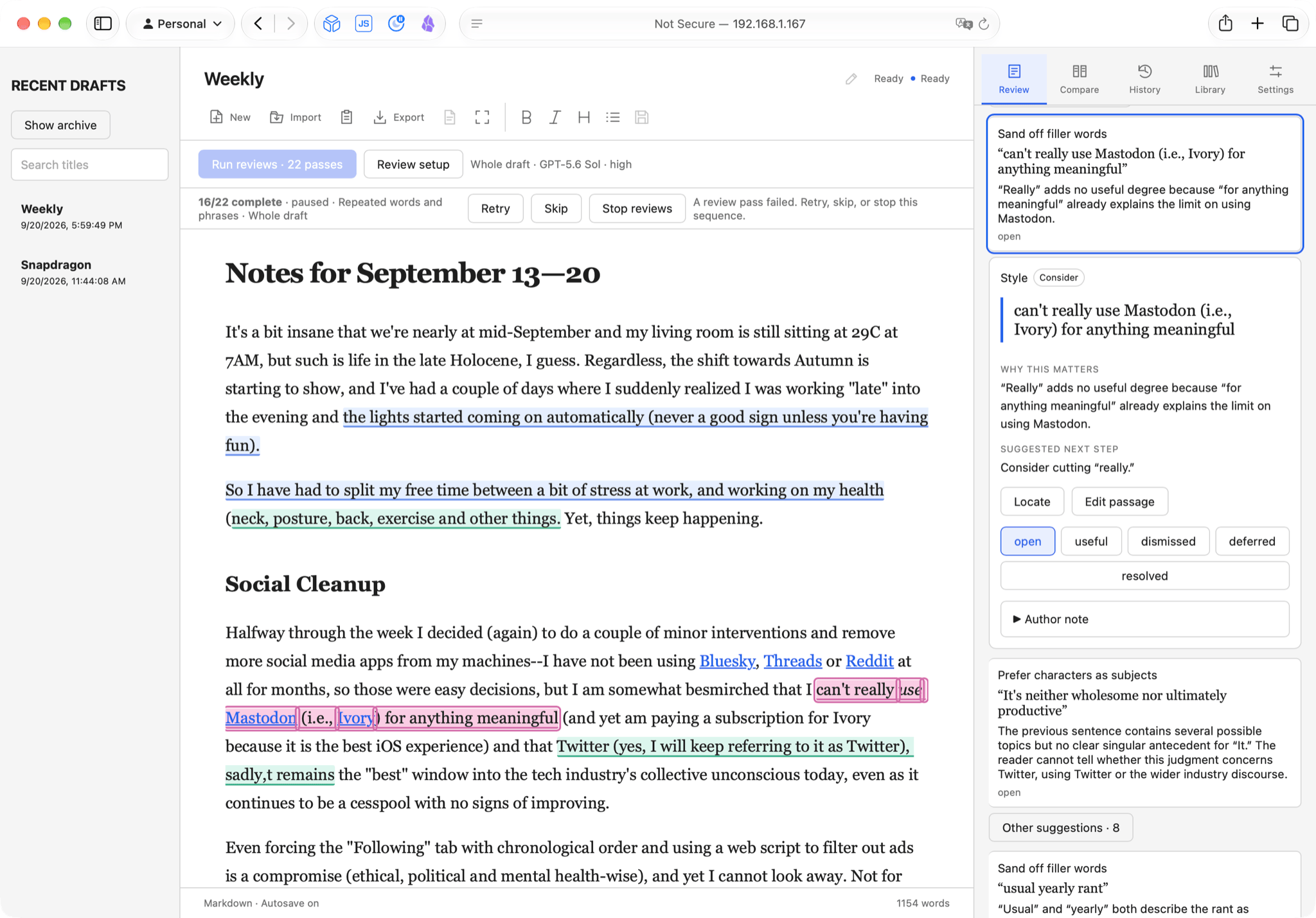
Of course there is a lot of polishing to do (my original intent was to add polish, not too much friction, and right now the 22 kinds of suggestions from the assistant are a bit overwhelming), but it’s a matter of tuning out what I don’t need and focusing on the improvements that truly impact the quality of the draft.
And then, who knows, maybe this will evolve into something even more substantial.
Books
But what I’m most happy with is that I finished both Norse Mythology and Last and First Men this week, which is a positive data point in my return to reading.
I did get piclaw to go into GoodReads and mark them both as read for me from my Nomad, so it wasn’t a completely AI-free experience, but I am pretty sure my priorities are OK.